

A useful correction does two jobs at once: it protects what matters and teaches the next skill.
This page is for the first 60 seconds after a child does something wrong, strange, messy, or socially embarrassing. Those seconds decide whether the child learns observation, shame, fear, repair, or responsibility.
The aim is not permissive parenting. If a child harms safety, rights, or dignity, the adult sets a clear boundary. If the child lacks a skill, the adult teaches the next step. If the issue is mainly a social rule, the adult explains the rule without making the child feel defective.
The Five Lenses
Use these lenses before correcting a child. They help adults respond with firmness without shame.

 Mistake
 Boundary
 Missing Skill
 Social Rule
 Repair
The Shoe Story
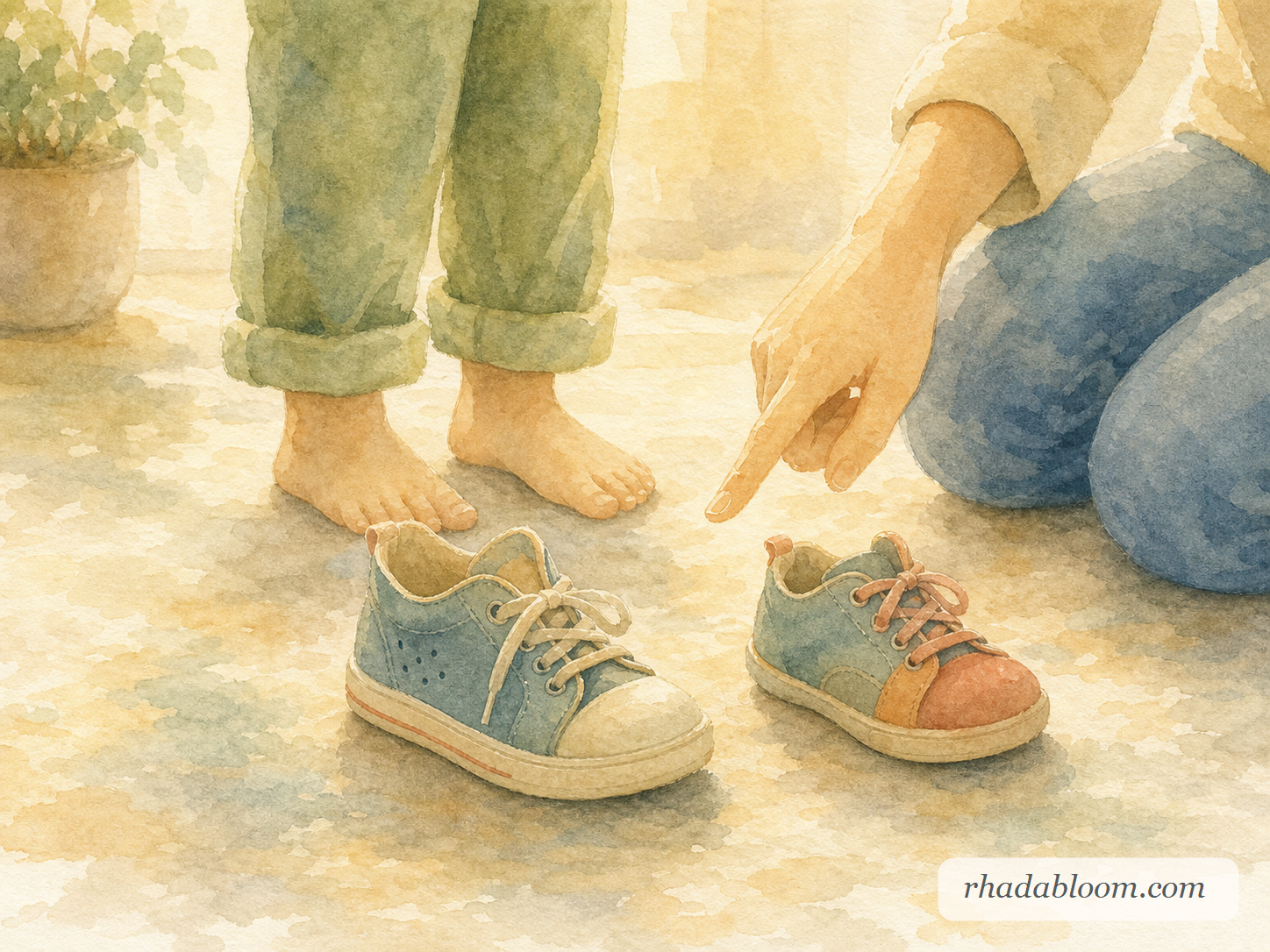
A six-year-old wears the wrong shoes because the shoes look similar. One shoe is the wrong size. Both may even be the same side. An adult can see the error quickly. The child may only feel, "I am wearing shoes, so I am ready."
The useful lesson is not, "How could you do this?" It is, "These shoes look similar, but feet need the right side and the right size. Let's compare: size, side, name, and how your foot feels."
1
Slow the adult body first.
Correction lands better when the adult's tone says, "You are safe while you learn."
Correction lands better when the adult's tone says, "You are safe while you learn."
2
Name the reality.
"This is the right shoe, but it is not your size. Your foot needs a shoe that fits."
"This is the right shoe, but it is not your size. Your foot needs a shoe that fits."
3
Make the child compare.
"What is different? Size, side, name, or feeling?" Observation becomes a skill.
"What is different? Size, side, name, or feeling?" Observation becomes a skill.
Scripts for Adults
These scripts keep the boundary clear while protecting the child's sense of dignity. Use short sentences first; explain more only after the child is calm.
"Why did you do that?"
"Pause. I will help. This is what happened. The next step is..."
"I will not let you hurt a body. You can be angry, and I will help your hands stay safe."
"Your body was trying, but the skill is not ready yet. I will show you once, then you try."
"This rule helps people in this place. It is not about you being bad. It is about how this group works."
"You can make this better. Choose one: clean it, return it, apologize, or try again slowly."
Reflection Tool
Use this before deciding whether the child needs a boundary, a lesson, practice, or repair.
1. Was anyone's safety, body, belongings, dignity, or rights affected?
2. Could the child realistically know and do the expected action at this age?
3. Is the issue mostly a social rule, a group habit, or an appearance expectation?
4. Is there a concrete repair the child can do now?
Start with the kindest accurate question.
Choose one answer in each row. The goal is not to excuse behavior. The goal is to match the adult response to the real problem.
Adult move: breathe, get close, lower your voice, and describe what you see.
Child move: notice one detail and try one repair.
The 3-Minute Repair Routine
Children do not need adults to pretend every action is fine. They need adults who can separate the child's worth from the child's behavior, then help the child return to safety and try again.
This routine is short enough for everyday use. It works for small mistakes, messy moments, and social-rule corrections. For serious harm, protect safety first and repair later.
A
Pause
Adult: lower voice and get close. Child: stop the action and breathe once.
Adult: lower voice and get close. Child: stop the action and breathe once.
B
Name
Adult: say the exact issue. Child: point to what changed, broke, hurt, spilled, or confused them.
Adult: say the exact issue. Child: point to what changed, broke, hurt, spilled, or confused them.
C
Repair
Choose one concrete action: clean, return, re-try, say sorry, ask for help, or practice the missing skill.
Choose one concrete action: clean, return, re-try, say sorry, ask for help, or practice the missing skill.

Research Base
This resource is built from child development, positive discipline, executive function, and moral versus social-conventional reasoning. It is educational, not medical advice.
The AAP recommends discipline that teaches behavior, sets limits, listens, notices positive behavior, and avoids yelling or shaming because harsh verbal discipline can be harmful.
HealthyChildren.org: What's the Best Way to Discipline My Child?The CDC frames consequences as what happens immediately after behavior and emphasizes specific, age-appropriate directions that tell children what to do.
CDC: Tips for Using ConsequencesCDC: Steps for Giving Good Directions
Responsive back-and-forth interaction builds brain architecture. Executive function skills are not fully present at birth; children develop them through practice and support.
Harvard: A Guide to Serve and ReturnHarvard: Building the Brain's Air Traffic Control System
Research on moral and conventional reasoning shows that children can distinguish harm, rights, and justice from social customs and authority-dependent rules.
Stanford Encyclopedia: The Moral/Conventional DistinctionMeta-analysis: Moral and conventional judgments in childhood